At the beginning of 2009, I started looking around for a more efficient and healthy way to move, which first led me to barefoot types of shoes, like Vivo Barefoot and Vibram FiveFingers. During my internet searches, I stumbled upon a link to PoseTech.com, which promised a way to reduce running injuries through an extremely efficient technique. Dr. Nicholas Romanov, creator of the Pose method, asked why people were taught how to play basketball and football, throw shotput, and play other sports, but were never taught how to run. He believes there is a proper technique that can be used to run.
The existing technique of landing on the heel and then pushing off into a wide stride is just as inefficient as a new runner going out there and doing what feels natural. Over 50 percent of runners get injured every year, and a third of those are knee joint injuries. Even with the "advances" in the shoe industry, the injury rates have remained consistent over the past 25 years. Obviously, "just running" is not working for many people.
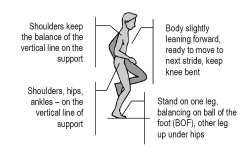
The Pose method looks at running as a technical skill of movement, and believes it should be taught like one, with its own theory, rules, practice exercises, and more. Aerobic conditioning can only take you so far: an efficient movement is necessary to achieve maximal speed and distance. Pose breaks running down into three simple parts: the running pose, the fall, and the pull. Pose --> Fall --> Pull. Even simpler, all you have to do to run is to change support from one leg to the other by pulling the support foot from the ground. It sounds quite simple, but it takes a lot of practice to retrain your muscle memory to learn the movement, and to unlearn old habits.
The four forces acting up on the body in movement are gravity, muscle elasticity, ground reaction, and muscle contractions. These forces drive the body forward when they are unbalanced. The runner must create a constant state of unbalance to allow the gravity force to drive the body forward. Running comes down to the level of skill of the runner to interact with gravity throughout the gait cycle, and use the gravity to move forward. To break balance and fall forward, the weight of the body must be on the ball of the foot (BOF) exactly like in barefoot running. Landing on the toes or the heel is not as efficient as a BOF landing, and this may be one of the biggest adjustments for runners practicing the Pose method.
While it may be difficult to master, running in the Pose technique is quite simple. Your main goal, besides Pose-->Fall-->Pull, is to get your own body out of its way, and let gravity do all the work. Here are a list of errors that occur from either trying too hard or from incorrect form. And remember, pain is the body's reminder that you're doing something wrong, so don't ignore what your feet and joints are telling you.
Running Errors
All information was taken from the "Pose Method of Running" book or a clinic manual, both written by Dr. Nicholas Romanov. I highly recommend checking out the book and the articles and discussions on Posetech.com for more information. I also highly suggest attending a clinic with a certified coach to ensure you're properly running using the Pose method.
The existing technique of landing on the heel and then pushing off into a wide stride is just as inefficient as a new runner going out there and doing what feels natural. Over 50 percent of runners get injured every year, and a third of those are knee joint injuries. Even with the "advances" in the shoe industry, the injury rates have remained consistent over the past 25 years. Obviously, "just running" is not working for many people.
The Pose method looks at running as a technical skill of movement, and believes it should be taught like one, with its own theory, rules, practice exercises, and more. Aerobic conditioning can only take you so far: an efficient movement is necessary to achieve maximal speed and distance. Pose breaks running down into three simple parts: the running pose, the fall, and the pull. Pose --> Fall --> Pull. Even simpler, all you have to do to run is to change support from one leg to the other by pulling the support foot from the ground. It sounds quite simple, but it takes a lot of practice to retrain your muscle memory to learn the movement, and to unlearn old habits.
The four forces acting up on the body in movement are gravity, muscle elasticity, ground reaction, and muscle contractions. These forces drive the body forward when they are unbalanced. The runner must create a constant state of unbalance to allow the gravity force to drive the body forward. Running comes down to the level of skill of the runner to interact with gravity throughout the gait cycle, and use the gravity to move forward. To break balance and fall forward, the weight of the body must be on the ball of the foot (BOF) exactly like in barefoot running. Landing on the toes or the heel is not as efficient as a BOF landing, and this may be one of the biggest adjustments for runners practicing the Pose method.
While it may be difficult to master, running in the Pose technique is quite simple. Your main goal, besides Pose-->Fall-->Pull, is to get your own body out of its way, and let gravity do all the work. Here are a list of errors that occur from either trying too hard or from incorrect form. And remember, pain is the body's reminder that you're doing something wrong, so don't ignore what your feet and joints are telling you.
Running Errors
- Landing with the heel first - land on the ball of your foot (BOF)
- Heel strike with a straight leg - recipe for hurt knee and joints
- Landing ahead of the body, aka overstriding - keep your general center of mass (GCM) in line with your BOF
- Using quad muscles instead of the hamstrings (push off), and pulling the swing thigh and knee forward and up - pull the leg up with your hamstrings
- Landing on the toes with the body behind landing/foot - land on your BOF in line with your GCM
- Landing with stiff ankles/leg - relax the ankles and let them absorb the impact
- "Active landing" - don't place your foot on the ground, let it fall naturally with gravity
- Overall muscle tension - remember to stay loose, not rigid, even in your neck, back, and shoulders
- Active push/toe off, straightening the leg to propel the body forward - there is no need to push off and strain the calf muscle, just fall forward and let gravity do the work
- Holding the rear leg behind after leaving the support - allow the foot to drop back to the ground
- Leaning the trunk sideways or forward - lean from the ankles, not your waist, unless you want lower back pain
- Keeping the shoulders up and stiff - just relax!
- Arms pumping - keep elbows relaxed and back, with the thumbs alongside your ribs
All information was taken from the "Pose Method of Running" book or a clinic manual, both written by Dr. Nicholas Romanov. I highly recommend checking out the book and the articles and discussions on Posetech.com for more information. I also highly suggest attending a clinic with a certified coach to ensure you're properly running using the Pose method.
 RSS Feed